
.png)
For years, we were taught that marketing was like a funnel: you pour a lot of people in at the top, some go down, and a few come out the bottom as customers. But what happens next? In the traditional model, the customer "drops out" of the system and we have to start over from scratch, spending more budget to fill the funnel again. It's a grueling and, frankly, increasingly expensive race.
Recently, talking with our team after the HubSpot Partner Community Day in Mexico, we came to an inevitable conclusion: that linearity is dead. The modern buyer in Latin America no longer follows a straight path. Today, our customers are on TikTok, consult ChatGPT, jump to LinkedIn and come back to Google us, all in the same afternoon.
As Gabriela from our sales team rightly mentioned, "We no longer talk about 'what's next,' we talk about what's already here. Today's buyer is distracted and moves through multiple touch points. If your strategy is not circular, you are losing track of your customer."
What exactly is Loop Marketing and why should you care?
The Marketing Loop (or marketing cycle) is not just a name change for the old Flywheel. It's an evolution that recognizes that growth is not the result of a one-off effort, but a constantly evolving process that matches the actual way people buy today: fast, sometimes impulsive and always AI-informed.
Unlike the funnel, which stops when the sale is made, the Loop is a compound growth system. Imagine a wheel: once it starts spinning, each rotation requires less energy and produces more speed.
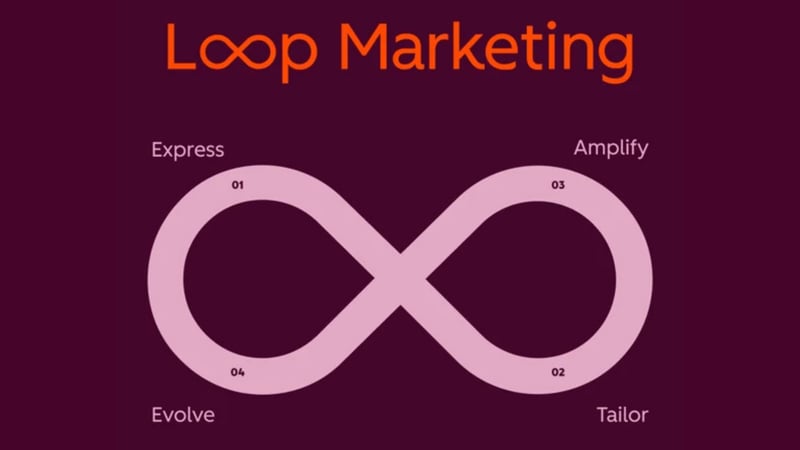
The 4 stages of the Loop that will transform your business
To implement this in your company, we need to break down the stages that we discussed intensively during the HubSpot sessions and that we are already applying at Digitalegy:
1. Express: Identity in the face of AI.
This is where you define your buyer persona and your brand voice. But in 2025, this has a twist: your identity must be so clear that AI can "read" you and recommend you. One practical technique we recommend is to collect all your current customer reviews and feed them into an AI to identify real language patterns. This will allow you to create a style guide that not only attracts humans, but positions your brand in generative engines (GEO).
"Technology gives us speed, but our specialization gives value," Gabriela reflects. Defining who you are is the first step to make that technology work in your favor.
2. Tailor: The end of "one size fits all".
At this stage, we take that brand voice and personalize it to the extreme. We no longer send the same email to 1,000 people. We use tools like HubSpot' s Data Hub to clean data and segment intelligently. If a client in Colombia is looking for affordable solutions and one in Mexico is looking for corporate scalability, the Loop adapts to show them different content.
To learn more about how design impacts this stage, we invite you to read our blog on: What is web design and what is it for? where we explain how the interface is your first adaptation tool.
3. Amplify: From static to dynamic content
Does your content stay stored in a blog and nobody reads it? In the Loop, content needs to move. This is where AI engine optimization (AEO/GEO) comes in. It's not about writing for Google, it's about answering direct questions.
-
Pro Tip: Take your best videos or blogs and use AI to reframe them into "Q&A" format. This is what powers virtual assistants today.
On this paradigm shift, you can check out our analysis: The Future of SEO: AI is changing search with GEO Optimization.
4. Evolve: The secret of compound growth
This is my favorite part. This is where you stop guessing. You analyze your top three campaigns for the quarter, run the data through AI and figure out which elements really moved the needle. By iterating on what's already working, you don't start from scratch every month; you build on previous success.
Practical application in Latin America: Where to start?
We know that in our region, the challenge is often the order and quality of information. As we observed at Partner Day, the biggest "headache" for scaling is having messy data in a thousand spreadsheets.
To implement Marketing Loop today in your SMB or growing company, we suggest these three steps:
-
Clean up your digital house: use tools (like Data Hub) to keep your contacts real and up to date. AI can't help you if your data is a mess.
-
Listen to your post-sales customer: In the Loop, the "Delight" moment is the fuel for the next churn. A happy customer who leaves a review is the best asset for your "Attract" stage.
-
Adopt the RevOps model: Align your sales and marketing teams. If sales knows what content attracted the customer, you can close the sale with greater empathy. More on this in: RevOps: Key to Sustainable Growth.
Key lesson: Technology is the engine, you are the pilot.
The big lesson we took away from Mexico is that AI is not going to replace strategy. On the contrary, it makes it more necessary than ever. At Digitalegy, we confirmed that our value proposition is not just to "configure HubSpot," but to be that ally that understands the behavior of the Latin American buyer and uses technology to make the Loop flow without stopping.
Questions for your weekly reflection:
-
If you stopped investing in paid ads today, would your marketing continue to generate leads thanks to your current customers?
-
Are you answering the questions your customers are asking ChatGPT, or are you still writing for a 2018 algorithm?
Change is already here. The question is not whether the Loop will replace the funnel, but who in your industry will leverage it first to stop chasing customers and start attracting them organically and perpetually.
Ready to transform your strategy? At Digitalegy we are experts at making technology work for your growth. Schedule a free consultation here and let's get your Marketing Loop spinning.
Don't forget to share this post!
